

Marketing Strategy Implementation: Why Execution Breaks Down
Marketing strategy implementation rarely fails at the planning stage alone. A strategy can be approved, budgets allocated and responsibilities assigned, yet execution becomes unpredictable when decisions are repeatedly reopened. The result is often less visible than a failed campaign: additional revision cycles, delayed launches and time diverted from optimisation.
This is not an argument against executive oversight. Leadership should set direction, protect the brand and challenge weak assumptions. The question is whether organisations have a dependable way to distinguish strategic oversight from day-to-day operational intervention.
Why marketing strategies break down during execution
This is a broader management challenge, not simply a complaint about approvals. In its 2026 CMO Spend Survey, Gartner reported that 70% of surveyed CMOs considered their internal marketing processes insufficiently mature to implement and scale AI effectively. That finding concerns AI readiness—not executive interference—but reinforces the importance of operational capability alongside strategic ambition. The survey covered large organisations in North America and Europe, so it should not be treated as a Malaysia-specific benchmark.
In marketing leadership roles, I have experienced situations where senior decision-makers revisited work after teams had already invested time in execution. These situations extended beyond branding into several marketing disciplines. The most immediate consequence was repeated revisions and duplicated effort—not necessarily a measurable drop in revenue that could be attributed to one decision.
Practitioner insight: A changed decision has consequences beyond the new direction: completed work may need to be redone, approvals repeated and launch opportunities delayed.
That distinction matters. A revision may be justified by new evidence, a market shift or a genuine compliance concern. But when decisions change without a documented reason or clear owner, teams struggle to distinguish necessary course correction from avoidable rework.
How marketing approval decisions create rework
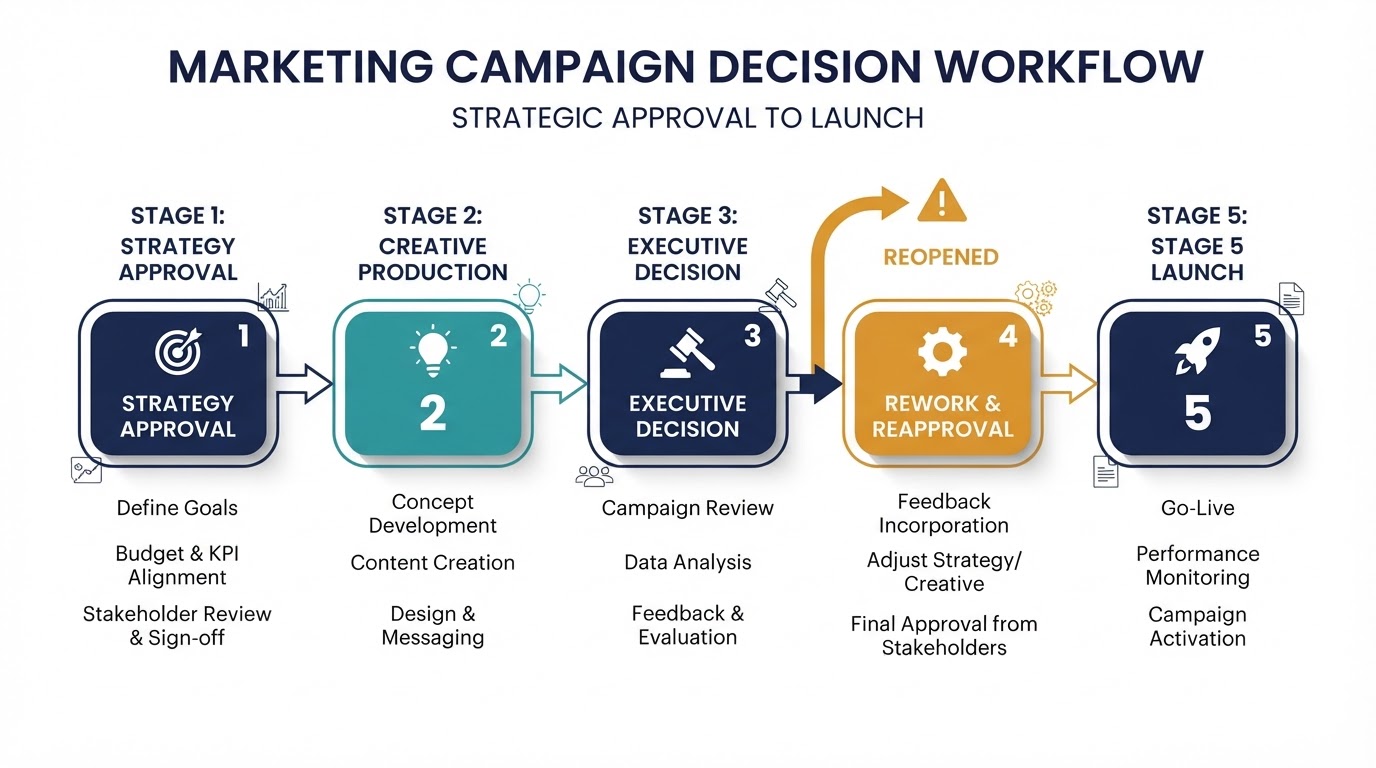
The following workflow illustrates how a single late-stage change can affect an otherwise straightforward campaign. It is a hypothetical process example, not a record of a specific client engagement.
Control point: record the reason for changes, decision owner and impact on schedule before restarting production.
The additional challenge: Brand, digital and data expertise
The scale of the shift matters: Gartner’s 2025 CMO survey found digital channels accounted for 61.1% of marketing spend among surveyed large businesses in North America and Europe. This is not evidence that brand-focused leaders lack competence. It shows why digital performance literacy is now relevant to many marketing decisions, while brand and commercial judgment remain essential.
Modern marketing decisions increasingly combine brand positioning, paid media, SEO, CRM, analytics and customer experience. These disciplines do not always share the same success metrics. A brand-oriented leader may reasonably focus on consistency and long-term perception, while a performance specialist focuses on conversion quality, acquisition costs and campaign learning.
Neither perspective is automatically superior. A high click-through rate does not prove commercial success; equally, a creative direction that feels consistent with the brand may still perform poorly with the intended audience. The problem arises when a decision is made without identifying which evidence matters, who can interpret it and which trade-offs are acceptable.
How digital marketing performance can be misinterpreted
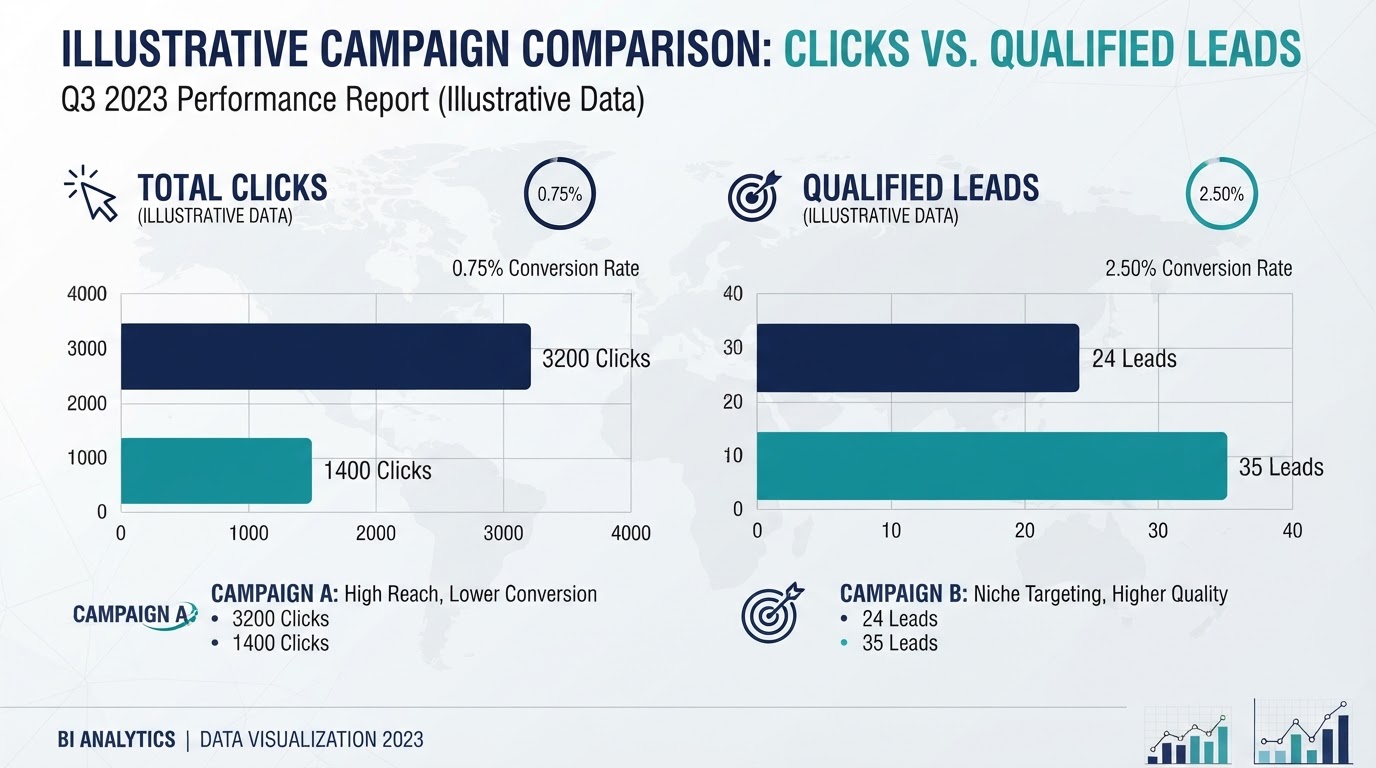
Consider two hypothetical lead-generation campaigns. Campaign A attracts more clicks, but Campaign B produces a larger share of qualified leads. The figures below are illustrative only and are not MoxTeam or client results.
| Metric | Campaign A | Campaign B |
|---|---|---|
| Impressions | 100,000 | 100,000 |
| Clicks | 3,200 | 1,400 |
| CTR | 3.2% | 1.4% |
| Leads | 96 | 70 |
| Qualified leads | 24 | 35 |
| Qualified-lead rate | 25% | 50% |
Campaign A — 0.75
Campaign B — 2.50
This is why marketing operations should connect strategic objectives to a common measurement framework. Brand judgment and digital analytics need to inform one another rather than compete for authority. In the example, Campaign B generates more qualified leads from fewer clicks, but it cannot automatically be declared the winner: the teams must also compare media spend, sales conversion, customer value, brand suitability and the reliability of lead qualification. A sound decision specifies which evidence is decisive before performance is reviewed.
How to measure the cost of marketing revisions
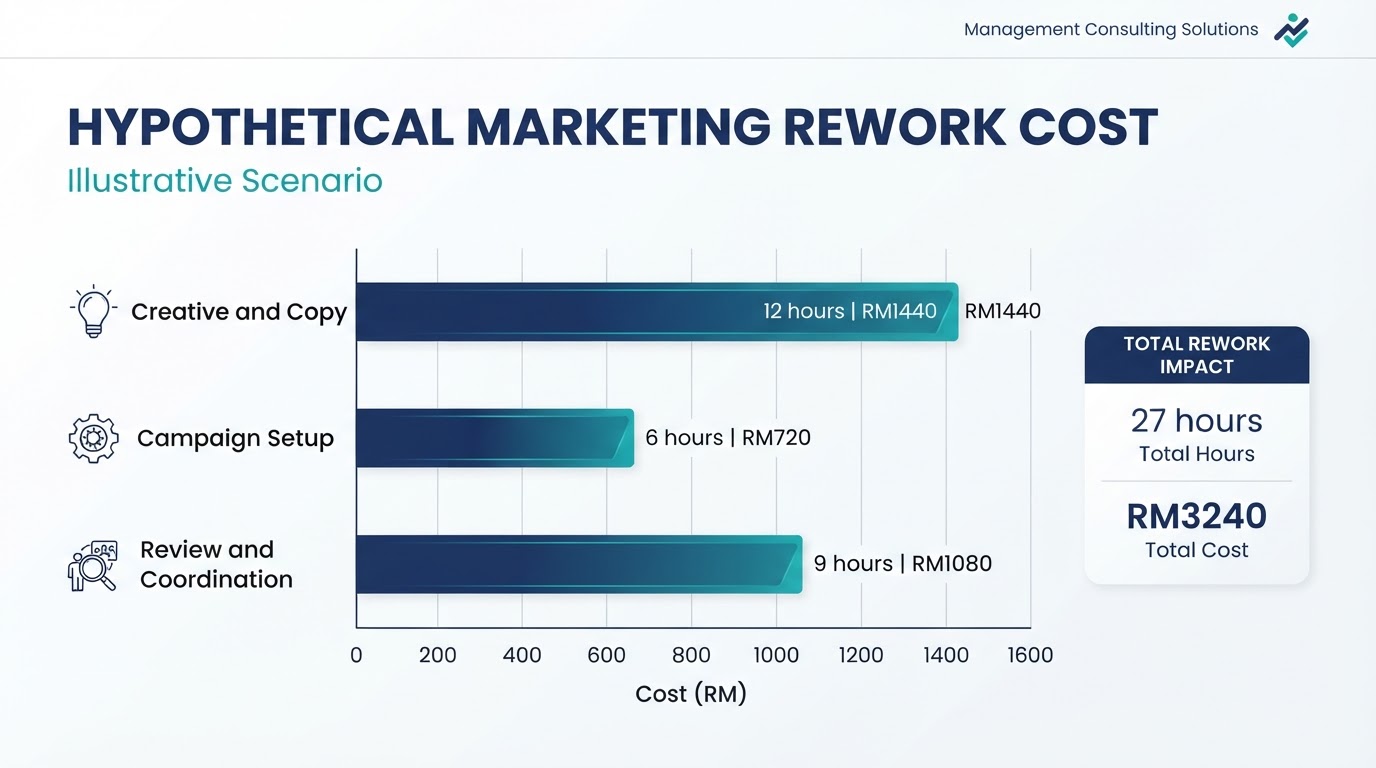
A simple rework ledger can make the impact visible. Assume a team has three unplanned revision cycles affecting design, copy, campaign setup and management review. The example below uses hypothetical hours and an assumed blended internal cost of RM120 per hour.
| Activity | Extra hours | Illustrative cost |
|---|---|---|
| Creative and copy revisions | 12 | RM1,440 |
| Campaign setup changes | 6 | RM720 |
| Stakeholder review and coordination | 9 | RM1,080 |
| Total | 27 | RM3,240 |
The point is not that executives should stop changing decisions. It is that significant changes should carry a visible cost and a documented business rationale.
Marketing operations dashboard: Four execution KPIs
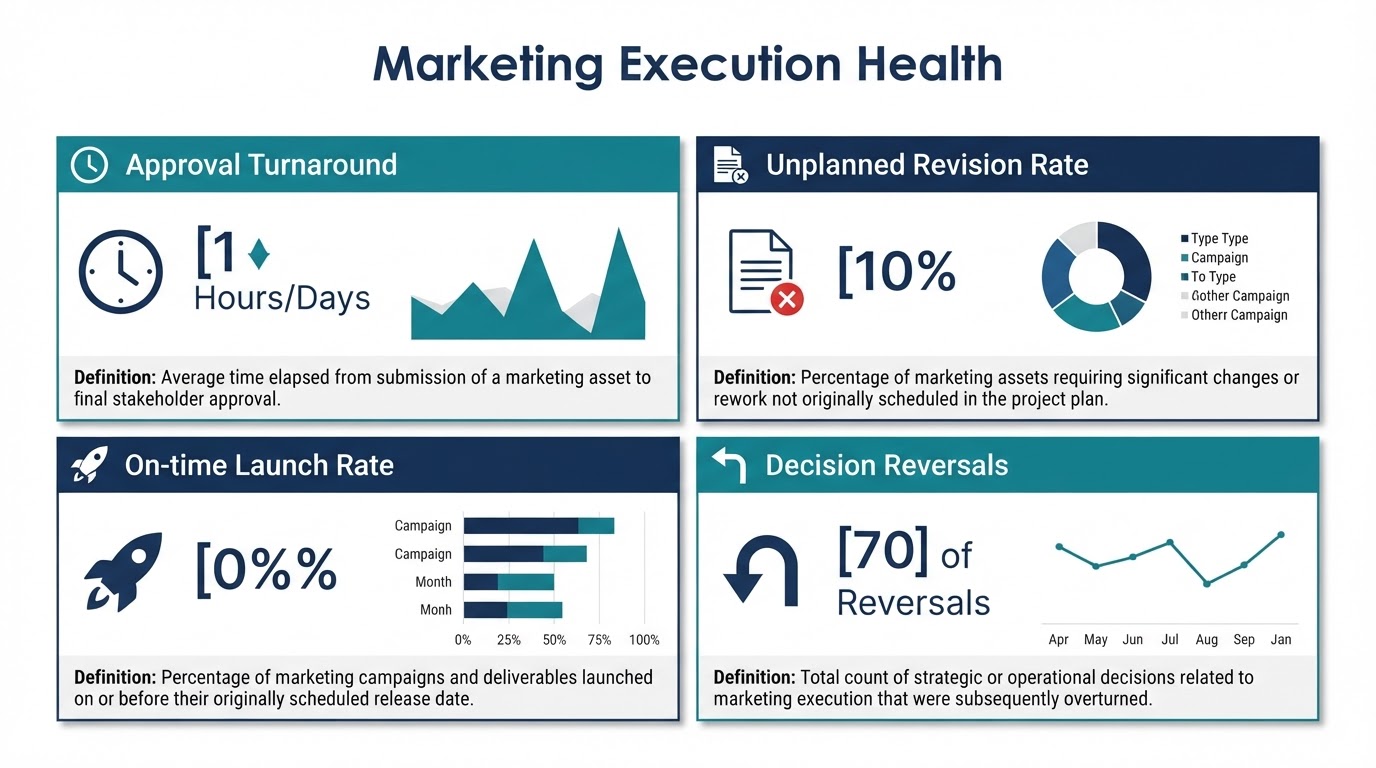
Implementation note: Start with a four-week baseline and review trends by campaign type. Avoid treating a higher revision rate as automatically negative: complex launches, regulatory reviews and necessary course corrections can legitimately require more changes. The scorecard is useful only when the reasons for revisions are recorded alongside the counts.
Instead of measuring marketing teams only by output and campaign KPIs, management can monitor a few operational indicators that reveal whether the execution environment is working.
| Indicator | Definition | Management question |
|---|---|---|
| Approval turnaround | Median business days from submission to decision | Where are approvals slowing delivery? |
| Unplanned revision rate | Assets requiring material change after sign-off ÷ approved assets | Are decisions staying settled? |
| On-time launch rate | Campaigns launched by agreed date ÷ campaigns scheduled | Is execution predictable? |
| Decision reversals | Count of previously approved decisions materially changed | Are exceptions becoming routine? |
How to diagnose the real cause before changing governance
Repeated revisions alone do not prove that leadership is interfering unnecessarily. Before changing the approval process, review a sample of recent decisions and ask whether the original brief was complete, whether the recommendation addressed the agreed business objective, and whether new information justified the change. A decision reversal prompted by new compliance requirements or credible customer evidence is different from an unexplained preference change after sign-off.
A practical diagnostic is to classify each material revision as new evidence, incomplete brief, execution error, strategic change or preference-based reversal. Record who requested it, when it occurred, the work affected and the decision rationale. Only then can management identify whether the remedy is better briefs, stronger specialist capability, clearer approval authority or more disciplined change control.
5 questions to improve marketing strategy implementation
Use these questions before the next campaign handoff. When marketing strategy implementation stalls, the answers can help distinguish a missing decision owner from a problem with the brief, the evidence or the team’s capacity.
A practical operating model does not require a complex governance manual. It needs clear answers to five questions:
- Who owns the outcome? Set the business objective and accountable decision-maker before production begins.
- Who advises on the evidence? Involve brand, performance, analytics and relevant specialists where their expertise is material.
- What requires executive approval? Reserve senior sign-off for strategic, reputational, financial or material risk decisions—not every routine optimisation.
- What happens when direction changes? Record the reason, expected benefit, rework cost and revised deadline.
- How will the team learn? Review both business outcomes and operational friction, without confusing correlation with causation.
These practices will not fix a weak product, unrealistic targets or poor campaign execution. They do, however, help businesses identify when the operating environment itself is limiting delivery.
Bridging strategy, digital performance and execution
For Malaysian businesses, effective marketing strategy implementation increasingly requires the ability to translate brand objectives into measurable digital activities, interpret results in context and manage decisions consistently. This is where marketing strategy and marketing operations meet.
MoxTeam supports businesses with marketing strategy, SEO, paid media, analytics, CRM and marketing operations—helping teams move from recommendations to disciplined execution. For a practical example of budget controls and decision accountability, see Google Ads Agency Accountability: 7 Metrics That Matter. Reliable performance interpretation also depends on accessible reporting; our SEO reporting automation guide explains how GA4 reporting can support more consistent business decisions.
Need support connecting marketing strategy with practical execution? Contact MoxTeam to discuss your requirements.
Frequently asked questions
Why does marketing strategy implementation fail?
Common causes include unclear ownership, changing priorities, weak coordination, insufficient capabilities and decisions that are repeatedly reopened. The root cause must be assessed rather than assumed.
Is executive involvement in marketing decisions a problem?
No. Executive oversight is necessary for strategic direction and risk management. Problems arise when approval boundaries are unclear or routine decisions are repeatedly reversed without accounting for their impact.
How can marketing leaders bridge brand and digital marketing?
Use shared business objectives, appropriate metrics, specialist input and clear decision rights. Neither brand intuition nor digital metrics should be used in isolation.